


The plastic you choose for injection molding affects everything from production efficiency to product performance. As the global injection‑molded plastics market climbs from $337.5 billion in 2025 to a projected $361.8 billion by 2026, material selection has become a defining factor in large-scale manufacturing success.
To help you make a confident decision, this overview breaks down the most widely used injection-molding plastics, their defining characteristics, and applications across different industries.
The Importance of Choosing Plastic Material
Your choice of plastic goes beyond design and aesthetics, as these materials hold your product together. When comparing injection molding plastics, these factors should influence your decision.
- Performance and durability: How well will your product hold up in various environments? For instance, businesses in the automotive industry must use materials that can withstand varying loads, dynamic weather conditions, and exposure to engine heat and vibrations.
- Cost and manufacturing efficiency: With plastics, the cheapest choice isn’t always the best. You should also consider production cycle times, defect rates, and mold complexity, as these factors affect your final per-pound costs.
- Safety and compliance: Government and health regulations strictly dictate material selection in industries that handle consumable products, such as food, beverages, and pharmaceuticals. Governments are also pushing to reduce PFAS and other chemicals in plastic materials, which can affect resin selection and compliance planning. These rules protect your customers and your company’s liability by preventing plastic from contaminating your product’s contents.
- Aesthetics and feel: While not directly tied to performance, safety, or costs, a plastic’s feel still contributes to customer satisfaction. Plastic shapes the perceived quality and durability of products defined by their sensory experience, including consumer electronics and beauty packaging.
- Recyclability: Your resin choice can affect end-of-life options for products with short-term or single-use applications. Some injection molding polymers work well with established recycling programs or recycled content, while others have more limited recovery or reuse potential.
4 Injection Molding Plastics
While comprehensive databases list tens of thousands of polymer grades, manufacturers only use a handful in consumer products. Even so, it’s still crucial to understand the distinct profiles of the materials you choose. This knowledge on common plastics for injection molding will help your business balance performance, cost, flexibility, sustainability, and manufacturability.
1. Acrylonitrile Butadiene Styrene
ABS is one of the most widely used injection molding plastics across various industries due to its balanced properties. It is an impact-resistant thermoplastic ideal for engineering applications. Known for its rigidity, ABS is among the most durable and affordable polymers, with a wide array of applications.
Properties
ABS’s noteworthy characteristics include:
- High impact strength
- Excellent structural rigidity
- High-quality surface finish
- Strong electrical insulating properties
- Resistance to abrasion and strain
- High-dimensional stability
- Lightweight and low-density
These properties make ABS ideal for products that require durability, aesthetics, and high-volume production. It also has a wide processing window, making it one of the best materials for injection molding and 3D printing.
Limitations
While ABS has multiple benefits, its properties also have limitations, including:
- Low to moderate heat resistance
- Poor weather resistance
- Poor solvent resistance
- Susceptibility to stress cracking
- Restricted recyclability and no common curbside collection
- Inability to meet certain UL-rated properties in specific applications
Applications
ABS offers an excellent combination of high impact strength and rigidity, but it has poor outdoor weather and sunlight resistance. As a result, it’s ideal for products that rely on durability for indoor use. You can find it used in everyday items such as:
- Consumer electronics, including laptop casings, keyboard keycaps, and remote controls.
- Automotive components, such as interior trim, seat belt parts, and dashboard elements.
- Toys and recreational products, like LEGO bricks and plastic musical instruments.
- Medical devices, including nebulizers, equipment housings, and instrument panels.
2. Polypropylene
PP is another common plastic molding material and a cost-effective polymer known for its high durability. Manufacturers widely use it in mass market packaging, automotive components, and textiles.
It shares many properties with ABS, but businesses prefer it for applications such as food containers because of its high chemical resistance. PP works especially well for thin-wall rigid packaging, and newer methods have improved its clarity, bringing it closer to styrene and PET in select applications.
Properties
PP’s notable properties include:
- High fatigue resistance
- Good heat resistance
- Excellent chemical resistance
- High durability and flexibility
- High moisture resistance
- Moderate sustainability
- Strong thin-wall and clarity performance
- Compatibility with living hinges, including flip-top caps and closures
- Ability to meet most regulatory requirements with limited exposure to PFAS and other substances of concern
- Recyclability and curbside collection in many programs
- Use of recycled PP materials in applications that meet compliance and performance needs
Limitations
PP’s chemical properties give it disadvantages, such as:
- Poor UV resistance
- High flammability, though manufacturers can mitigate it more effectively than ABS. PP also does not smoke like ABS.
- Low scratch resistance
- Susceptibility to environmental stress cracking
Applications
Because of its high durability and chemical resistance, but poor UV resistance, PP is the go-to plastic molding material for products that require high chemical resistance without direct sunlight exposure. This includes:
- Food and beverage packaging, such as containers and bottle caps
- Automotive parts, such as bumpers and interior trim
- Textiles, such as ropes and carpets
- Rigid packaging, such as CD casings
3. High-Density Polyethylene
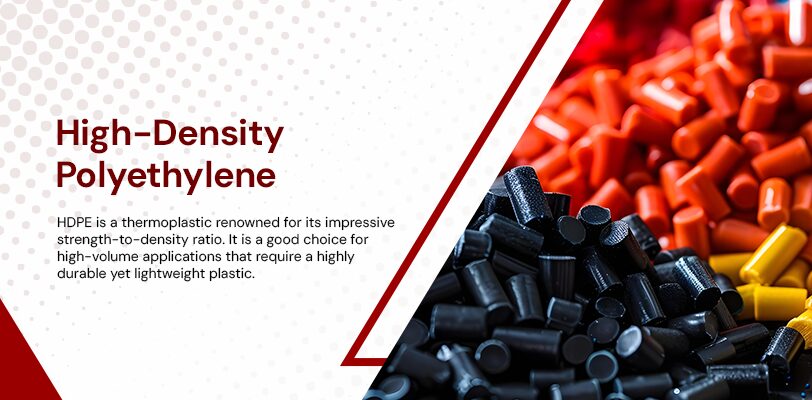
HDPE is a thermoplastic renowned for its impressive strength-to-density ratio. It is a good choice for high-volume applications that require a highly durable yet lightweight plastic. HDPE is also popular because of its weather resistance and affordability, making it ideal for consumer markets.
Properties
HDPE’s best characteristics include:
- Excellent strength-to-density ratio
- High chemical resistance
- High recyclability
- Excellent UV resistance with stabilization
- Nontoxic properties in food-grade applications
- Highly recycled resin with curbside collection in many programs
Limitations
Though HDPE is durable and lightweight, it has potential drawbacks:
- Poor adhesion and difficulty in bonding
- High flammability
- Susceptibility to stress cracking
- Lower stiffness compared to polymers such as polypropylene
- Potential PFAS content from processing aids
Applications
Due to these properties, manufacturers use HDPE across a wide range of large-scale manufacturing applications, such as:
- Packaging and containers, such as caps, closures, jars, and rigid container components
- Piping systems, such as potable water mains and sewage systems
- Consumer goods, such as playground equipment and trash cans
4. Polycarbonate
PC is a high-performance, transparent thermoplastic known for its unmatched durability compared to other polymers. Because of its toughness, businesses note PC as one of the best plastics for injection molding and an excellent alternative to glass in safety-critical applications.
However, PC typically costs more than PE and PP, making it a better fit for applications that require its specific strength, clarity, or impact resistance.
Properties
PC’s properties comprise:
- Durability
- Unmatched impact strength
- Extreme transmittance
- Lightweight
- High UV resistance, heat resistance, and optical clarity
Limitations
While manufacturers prefer PC for its durability, it also has shortcomings:
- High cost
- Poor chemical resistance
- Low scratch resistance
- Contains BPA
Applications
With its mix of durability and transmittance, PC is excellent for:
- Automotive parts, such as headlight lenses, sunroofs, and interior components
- Construction and industrial, such as skylights, roofing, bulletproof windows, and glazing
- Consumer electronics, such as smartphone housings, laptop cases, and electrical connectors


Frequently Asked Questions
If you’re exploring injection molding, you probably have questions about what you can make, your tooling options, and the size range for parts. Below, we’ve answered some of the most common questions about the injection molding process and how it applies to different projects.
The types of products that can be made with injection molding range from small medical devices to large automotive components. Everyday items like packaging caps, consumer electronics housings, and intricate parts for the healthcare industry are produced efficiently with this process. Some of the products we can manufacture include:
The types of tooling options available for prototyping versus high-volume production are quick-turn and soft tool alternatives. Prototype tooling is ideal for short production runs, market testing, and design validation. These options help keep costs down and allow for faster revisions. Alternatively, high-volume production uses hard tooling and multi-cavity molds to maximize output efficiency.
The typical minimum and maximum part sizes for injection molding range from several millimeters to several feet. Specialized equipment allows for large parts, but standard processes fall within a smaller window. Typically, mold precision capabilities determine minimum sizes, while press and mold design impact maximum size allowances.
You should choose The Plastek Group for injection molding because we’re an innovative leader, dedicated to quality, precision, and responsiveness. We offer end-to-end solutions, from initial design and prototyping to high-volume production and just-in-time delivery.
Our in-house tooling, engineering, and automation teams help streamline every project for efficiency and reliable results. With decades of experience serving industries like healthcare, personal care, and consumer goods, we’re prepared to tackle even the most complex manufacturing challenges.
Find the Right Processor for Your Plastic Injection Molding Needs
Looking for a reliable plastic injection molding processor? The Plastek Group has helped manufacturers across industries bring their visions to life with world-class injection molds for over 65 years.
The Plastek Group also assists in the decision-making process to determine which plastic best fits your industry and applications. With a global footprint, we serve clients in North America, South America, and the UK with consistent quality and excellence.
Request a quote today or contact us to speak with one of our experts and meet your production line’s needs.