



You’re evaluating suppliers for a new packaging project when unfamiliar terminology starts appearing everywhere. The engineering team discusses draft angles and lightweighting strategies. Manufacturers ask about resin preferences — PP versus HDPE versus PCR. Each conversation assumes you already understand the language. Navigating plastic packaging sourcing requires understanding the terms suppliers, engineers, and quality teams use daily.
This packaging terminology glossary defines the essential vocabulary that appears in spec reviews, design discussions, and sourcing conversations. With this knowledge, you can evaluate options confidently, ask informed questions, and participate throughout development.
Materials and Resins
Plastic resins form the foundation of rigid packaging components. Each material offers distinct properties suited to specific applications:
- Polypropylene (PP): A versatile resin widely used for closures, caps, and containers that require durability and chemical resistance. PP offers excellent moisture barrier properties and performs well across a range of temperatures. This makes it a popular choice for personal care products, health and beauty, home care, pharmaceutical and nutraceutical products, and food and beverage applications.
- High-Density Polyethylene (HDPE): A strong, rigid resin commonly used for jars and containers that need impact resistance and structural integrity. HDPE offers good chemical resistance and is well-suited for products requiring tamper-evident features or child-resistant closures in the home care and pharmaceutical and nutraceutical markets.
- Polyethylene Terephthalate (PET): A clear, lightweight resin favored for applications requiring transparency and product visibility. PET packaging offers strong barrier properties against oxygen and moisture, making it suitable for food and beverage, health and beauty, and pharmaceutical and nutraceutical packaging.
- Low-Density Polyethylene (LDPE): A flexible resin used primarily for tubes and containers requiring some give or flexibility. LDPE provides good chemical resistance and works well for personal care products like lotions and creams.
Understanding polymer properties and applications helps buyers select the right material for their specific packaging requirements.
Manufacturing Processes
These processes determine how packaging components are produced and what specifications are achievable:
- Injection Molding: A process where molten plastic resin is injected into a mold cavity under high pressure to create precise, repeatable parts. Injection molding produces caps, closures, jars, and containers with tight tolerances and consistent quality across high-volume production runs.
- Injection Blow Molding: A two-stage process that combines injection molding and blow molding to create hollow containers.
- Tooling: The molds, dies, and equipment required to manufacture plastic packaging components.
- Cycle Time: The duration required to complete one full production cycle, from injecting material into the mold to ejecting the finished part. Shorter cycle times increase production efficiency and reduce manufacturing costs.
- Cavitation: The number of parts a single mold produces in one cycle. Multi-cavity molds produce multiple identical parts simultaneously, improving cost efficiency for high-volume projects.
Design and Structural Terms
Design terminology appears in spec reviews, engineering discussions, and package development conversations. These concepts affect how packaging performs, how it’s manufactured, and how it functions for end users:
- Primary Packaging: The packaging that directly contacts the product and provides the first layer of protection. Primary packaging includes jars, tubes, and containers that hold the product.
- Secondary Packaging: Outer packaging that groups or protects primary packaging during shipping and retail display. Secondary packaging provides additional protection and facilitates handling throughout the distribution chain, complementing the rigid plastic containers that serve as primary packaging.
- Closure: The component that seals a container, including caps, lids, pumps, and dispensing systems.
- Finish: The threaded or sealing area on a container’s opening where the closure attaches. Finish specifications include diameter, thread style, and height.
- Draft Angle: The slight taper built into mold walls that allows finished parts to release cleanly from the mold.
- Wall Thickness: The measurement of material thickness in container walls and packaging components. Wall thickness affects structural strength, material usage, weight, and manufacturing feasibility.
- Lightweighting: The practice of reducing material usage and package weight while maintaining structural integrity and performance. Lightweighting reduces material costs, shipping expenses, and environmental impact without compromising package functionality.
Quality and Regulatory Terms
Quality and regulatory terminology appear frequently in pharmaceutical, nutraceutical, and personal care sourcing discussions. These terms describe performance requirements and safety features:
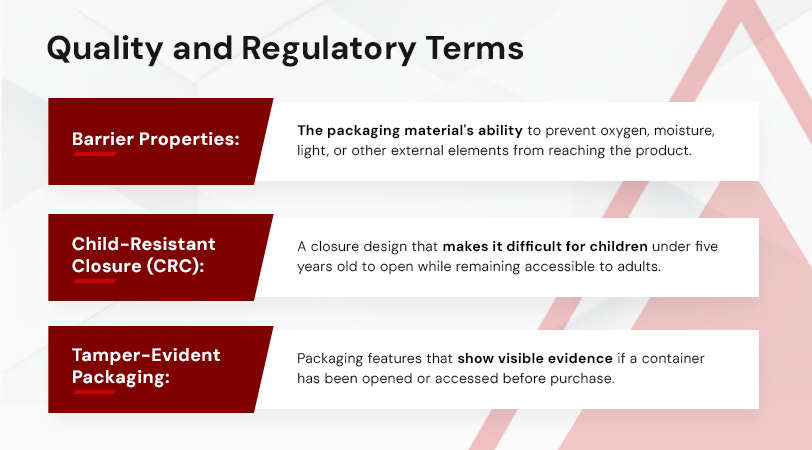
- Barrier Properties: The packaging material’s ability to prevent oxygen, moisture, light, or other external elements from reaching the product inside. Strong barrier properties extend shelf life and protect product integrity, particularly for food and beverage, pharmaceutical and nutraceutical, and health and beauty applications sensitive to environmental exposure.
- Child-Resistant Closure (CRC): A closure design that makes it difficult for children under five years old to open while remaining accessible to adults. CRC features are required for many pharmaceutical, nutraceutical, and household chemical products and must meet specific testing standards to ensure effectiveness.
- Tamper-Evident Packaging: Packaging features that show visible evidence if a container has been opened or accessed before purchase. Tamper-evident designs include breakaway bands, sealed caps, and other mechanisms that provide consumer confidence and meet regulatory requirements for many pharmaceutical, nutraceutical, and food products, where applicable.
Regulatory requirements vary by industry and region. Buyers should discuss specific compliance needs with packaging suppliers to ensure designs meet applicable standards.
Sustainability Terms
These sustainable packaging terms help buyers assess and communicate sustainability goals:
- Post-Consumer Resin (PCR): Plastic material recovered from consumer waste streams, processed, and reused in new packaging production. PCR content reduces reliance on virgin plastic and supports circular economy goals, though it may affect color consistency and require adjustments to processing parameters.
- Recyclability: The degree to which packaging materials can be collected, processed, and reused in new products through existing recycling infrastructure. Recyclability depends on material type, local recycling capabilities, and design features like multi-material construction or attached labels that affect sortability.
- Resin Identification Code (RIC): The numbered symbol (1-7) that identifies the plastic resin type. RIC codes help recycling facilities sort materials by resin category, with codes 1 (PET), 2 (HDPE), and 5 (PP) being widely accepted in many municipal programs. However, recyclability depends on the complete package design, local infrastructure capabilities, and features like multi-material construction or attached labels that affect processing.
Additional sustainability terminology and recycling definitions provide a broader context for buyers evaluating environmental considerations.
Get Started With The Plastek Group
Understanding packaging definitions is the first step toward sourcing with confidence. The next step is finding a partner who uses their expertise to support your success.
The Plastek Group has designed and manufactured rigid plastic packaging for decades. We serve personal care products, health and beauty, home care, pharmaceutical and nutraceutical products, and food and beverage brands. Locations span the U.S., UK, Brazil, and Mexico. Our capabilities span package development, custom design, tooling, and high-volume manufacturing.
When you’re ready to move from terminology to execution, Plastek’s experts bring technical knowledge and collaborative support to every project. Contact The Plastek Group to get started today.