


In September 2025, the FDA to nicotine pouch manufacturers mandating the use of child-resistant packaging. With pediatric exposure cases growing, gaining market authorization now hinges on implementing compliant, child-resistant nicotine pouch packaging solutions.
For manufacturers navigating this regulatory shift, the stakes couldn’t be higher. This guide provides a comprehensive roadmap to understanding the new compliance landscape, the specific federal standards you must meet, and how to partner with an experienced packaging manufacturer.
The Alarming Rise in Pediatric Exposures
Recent news about FDA-approved nicotine pouches reflects a troubling trend that regulatory agencies can no longer ignore:
- Exposure Surge: Nicotine pouch exposure cases reported to U.S. Poison Centers increased by 202% between 2022 and 2024, representing thousands of incidents.
- Children Most Affected: Approximately 72% of these cases involved children under five years of age.
- Low Toxicity Threshold: Toxic effects in young children have been reported with nicotine doses as low as 1-4 milligrams, an amount easily contained in a single pouch.
What makes nicotine pouches particularly hazardous to children? Their small, discreet size and colorful packaging can resemble candy or gum, making them appealing to curious kids. Unlike cigarettes or vaping devices, pouches require no equipment or activation — a child can simply place one in their mouth.
The concentrated nicotine content poses severe risks. Symptoms of nicotine poisoning in children include nausea, vomiting, increased heart rate, seizures, and, in severe cases, respiratory failure. Because young children have lower body weight and developing systems, even small doses can cause serious harm.
This rise in pediatric exposures prompted swift regulatory action. The latest nicotine pouch regulation news centers on how the FDA evaluates product applications. Child-resistant packaging has become the de facto requirement for gaining market authorization. Companies that fail to adapt risk being shut out of the market entirely, while better-prepared competitors move forward with approved products.
Understanding the De Facto Standard for Child-Resistant (CR) Packaging
The CR packaging regulations manufacturers must follow are rooted in decades-old federal standards originally designed to protect children from household chemicals and pharmaceuticals. Understanding these requirements is the first step toward achieving full compliance. Currently, all 20 FDA-approved nicotine pouch products use CR packaging.
CR packaging for nicotine pouches typically employs one of several proven mechanisms:
- Push-and-turn caps require users to simultaneously push down and rotate the closure, a motion difficult for young children to coordinate.
- Blister packs require complex movements when designed with peel-back or push-through features, which children may struggle to comprehend.
- Squeeze-and-turn designs require users to apply lateral pressure while turning, adding another layer of complexity.
The key is selecting a mechanism that provides effective child resistance while maintaining reasonable adult accessibility.
What Is the Poison Prevention Packaging Act (PPPA)?
The PPPA serves as the foundational federal law governing CR packaging in the United States. Enacted to prevent accidental poisonings among young children, the PPPA grants regulatory bodies the authority to mandate special packaging for hazardous substances. The act defines CR packaging as containers that are significantly difficult for children under five years of age to open within a reasonable time, and not difficult for normal adults to use properly.
What Are the Key Technical Requirements of 16 CFR Part 1700?
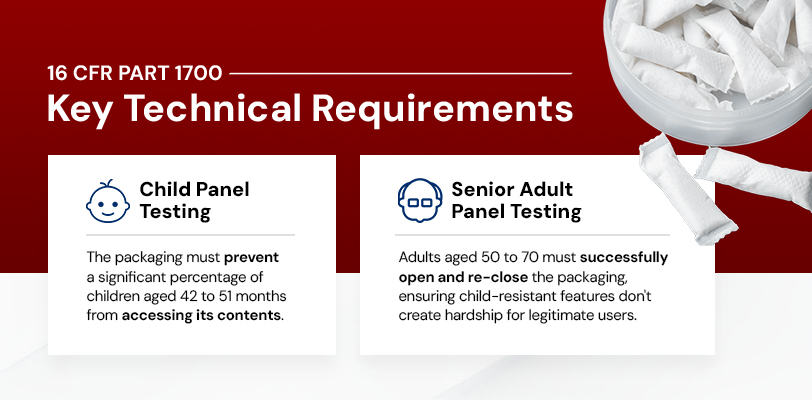
The 16 CFR Part 1700 outlines specific testing procedures for CR packaging. This rigorous testing evaluates packaging performance through two distinct validation panels:
- Child Panel Testing: Children aged 42 to 51 months attempt to open the packaging within specific time frames in controlled studies, and the packaging must prevent a significant percentage from accessing the contents.
- Senior Adult Panel Testing: Adults aged 50 to 70 must successfully open and properly re-close the packaging, ensuring child-resistant features don’t create undue hardship for legitimate users.
Your 3-Step Roadmap to Achieving Compliance
The following three-step roadmap provides manufacturers with a pathway to achieving full compliance while maintaining product quality and market timelines.
1. Choose a Manufacturing Partner With Proven CR Expertise
Your packaging partner can make or break your compliance efforts. The most critical step is selecting a supplier with a demonstrated track record. A partner with experience in pharmaceutical and nutraceutical markets will already understand the required materials, design principles, and testing protocols that make CR packaging effective.
This specialized expertise translates into tangible benefits for your business, such as faster development timelines, fewer costly design iterations, and reduced risk of regulatory rejection. Look for partners who can demonstrate successful CR packaging implementations, provide references from regulated industries, and offer in-house testing capabilities to validate designs before full-scale production begins.
2. Navigate the Package Design and Development Process
Developing compliant packaging requires close coordination between your team and your manufacturing partner. A strong package development process guides you through these essential milestones:
- Discovery and requirements review: Establish the project foundation by thoroughly analyzing your product specifications and regulatory requirements.
- Concept development: Create initial concepts that balance child resistance with adult accessibility, manufacturability, and cost-effectiveness.
- Rapid prototyping: Test functionality before committing to a full tooling investment to reduce risk and validate design performance.
- Testing iterations: Refine for multiple rounds to ensure the design meets both federal standards and your business objectives.
- Final validation: Test comprehensively to confirm the packaging achieves the right balance of safety, usability, and compliance.
3. Implement Quality Control for Long-Term Success
Compliance requires an ongoing commitment to rigorous quality control at every stage of production. Once you finalize your packaging design and production begins, implementing robust quality assurance protocols ensures every package coming off the line meets federal standards. Without consistent oversight, faulty batches can trigger costly recalls, invite regulatory action, and permanently damage your brand reputation.
Effective quality control in plastic manufacturing involves systematic testing, inspection, and documentation throughout the production process. From incoming raw material verification to in-process checks and final product validation, each step must be carefully monitored. Manufacturers with comprehensive quality programs build compliance into their standard operating procedures, giving you confidence that every package shipped meets the same exacting standards that earned your initial FDA authorization.
Get FDA-Approved Nicotine Pouches With The Plastek Group
Navigating new FDA requirements can feel overwhelming, but you don’t have to do it alone. The Plastek Group brings decades of manufacturing experience in regulated industries, including pharmaceutical and nutraceutical packaging, where child-resistant closures are standard.
From initial concept through production, we’ll ensure your nicotine pouch packaging meets every federal requirement. We’ve helped countless manufacturers achieve compliance in complex regulatory environments, and we’re ready to guide you through this transition. Contact us today to discuss your CR packaging needs and take the first step toward full FDA compliance.