


The food and beverage sector is navigating several packaging challenges. Consumer expectations around sustainability and convenience continue to rise, while e-commerce distribution demands durable in-transit performance. Staying competitive means understanding which trends represent temporary shifts and which signal long-term structural change.
From macro forces like global market growth to micro-level design innovations, today’s packaging decisions have implications, including brand differentiation, regulatory compliance, and supply chain efficiency. The latest innovations in food and beverage packaging reflect emerging trends that address these challenges.
Macro Trends in Food and Beverage Packaging
The concept of a trend might seem temporary, but macro shifts in food and beverage packaging run far deeper. These are large-scale structural forces reshaping how packaging is designed, sourced, and manufactured globally. Understanding current trends in food packaging helps businesses anticipate where the market is heading.
1. Global Market Growth and Rising Demand
Growth creates opportunity for brands ready to capitalize on it. The global food packaging market alone is expected to reach a value of $512 billion over the coming years.
As convenience and ready-to-eat foods become standard consumer expectations, brands need to evolve their food packaging materials to keep pace. Companies that adapt their packaging strategies can capture market share in an expanding sector.
2. Shelf Life Extension and Food Safety Innovation
Both the desire to extend shelf life and improve food safety drive trends in packaged food.
- Modified Atmosphere Packaging (MAP): This technology adjusts the internal atmosphere of packaging to slow spoilage and extend freshness.
- Vacuum Packaging: Removing air from packages reduces oxidation and microbial growth during storage and transit.
- Tamper-Evident Designs: This approach provides visible proof of package integrity, protecting brand reputation and consumer safety.
3. E-Commerce and Transit-Ready Packaging
Online and direct-to-consumer food delivery have fundamentally changed how brands approach packaging design and durability requirements. Global e-commerce food delivery revenue is projected to exceed $2 trillion in the coming years.
In this space, food packaging industry trends have shifted to packaging that reduces damage and provides an enjoyable unboxing experience. Businesses must maintain product integrity and presentation through packaging like insulated subscription boxes and bioplastic-lined paperboard.
Micro Trends in Food and Beverage Packaging
Micro trends in food and beverage packaging innovation represent small-scale, high-impact shifts in how packaging looks, how it functions, and how it communicates with a target audience. While macro trends tend to dictate the conditions in which a business operates, micro trends shape purchase decisions at the point of sale.
1. Personalization and On-Shelf Differentiation
Many businesses use custom packaging to stand out on crowded product shelves. Packaging that creates distinct visual elements and user-centric designs can build brand trust and loyalty in food and beverage products. These food packaging design trends deliver a meaningful brand experience that connects your customers to the concept you are selling.
Working with an experienced custom product design and development partner helps organizations translate brand strategy into manufacturable packaging solutions.
2. Convenience-Forward Packaging Formats
Ease and convenience drive purchase decisions. Packaging that opens easily, stores compactly, and reseals securely meets these expectations while enhancing daily user interactions. Caps and closures deliver this convenience across categories.
Formats such as flip-top closures or container caps and closures amplify the user experience. They are simple, easy to use, and tamper-evident, meeting both convenience and safety requirements in a single component.
Sustainability Trends in Food and Beverage Packaging
Businesses should be aware of the latest trends in sustainable packaging. When consumers evaluate packaging sustainability, recyclability consistently ranks as the most important trait. Beyond customer expectations, retail and regulatory requirements continue to grow, making sustainable packaging a future business necessity.
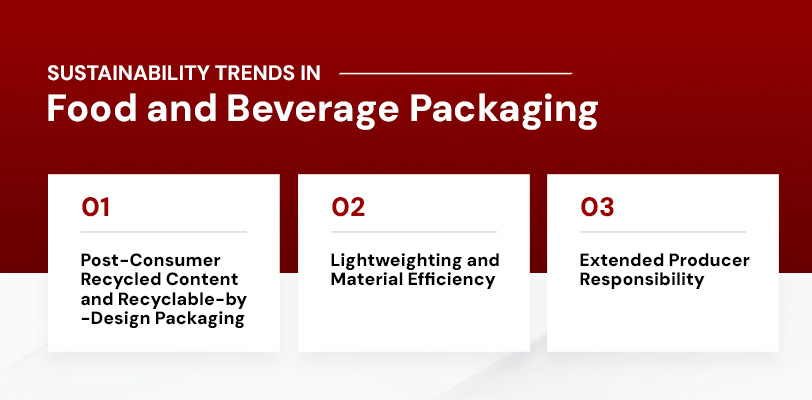
1. Post-Consumer Recycled Content and Recyclable-by-Design Packaging
Many food brands now integrate PCR materials. They are also designing those packages to be easily recycled at the end of life, creating a circular, sustainable loop. PCR resin integration is an active practice at innovative packaging processors with strong sustainability initiatives, supporting these circular economy goals. This approach allows businesses to meet retailer mandates, comply with emerging regulations, and respond to consumer preferences for recycled content.
2. Lightweighting and Material Efficiency
Lightweighting reduces packaging material while maintaining performance. This food and beverage packaging trend promotes the sustainable containment of goods without sacrificing structural integrity or protection. By using precision engineering to remove excess material, businesses can reduce costs, lower their carbon footprints, and optimize their supply chains.
3. Extended Producer Responsibility
EPR legislation holds brand owners and packaging producers financially responsible for the end-of-life management of their packaging. The EU has the Packaging and Packaging Waste Regulation as its primary EPR framework, while many U.S. states, including the following, have passed legislation:
- Maine
- Oregon
- Colorado
- California
- Minnesota
- Maryland
- Washington
No federal U.S. EPR packaging law exists yet, but brands that get ahead of these requirements will gain a compliance advantage. Understanding regional EPR obligations now prevents costly future redesigns.
Packaging Emerging Trends: What Is Next?
Emerging trends represent the next wave of food and beverage packaging innovation. These developments can dictate where forward-thinking businesses invest to maintain a competitive advantage. Trends to be aware of include:
- Smart Packaging communicates real-time information via RFID, NFC, QR codes, and sensors. It monitors temperature, time, and humidity throughout the cold chain, providing traceability and quality assurance data.
- Active Packaging actively intervenes to extend shelf life through MAP, antimicrobial properties, and oxygen scavengers. Active packaging responds to environmental conditions inside the package to preserve product integrity.
- AI-Driven Packaging enables real-time spoilage detection, shelf-life prediction, and blockchain-based traceability from production to consumer. These systems provide unprecedented visibility into product condition and supply chain performance.
- Barrier Technologies allow packaging to extend shelf life and meet recyclability goals. Advanced barrier solutions protect contents while supporting end-of-life recyclability requirements.
Monitoring these technologies allows businesses to evaluate which investments align with their product portfolios and market positioning.
The Plastek Group: Moulding the Future Since 1956
Across every trend, one constant remains clear: businesses need a manufacturing partner capable of turning strategic insight into tangible packaging solutions. The Plastek Group delivers full-service rigid plastic packaging capabilities for the food and beverage market. Our approach includes custom product design and development, injection molding, and quality assurance, all under one roof.
As a privately owned family business, we combine decades of expertise with global manufacturing reach across the U.S., UK, Brazil, and Latin America. We integrate PCR resin alongside PP, HDPE, PET, and LDPE to support circular economy goals. Every account receives a dedicated account manager, customer service representative, project manager, and quality engineer to partner with. Explore our food packaging solutions to learn more.