


Plastic packaging decisions are pivotal for manufacturers. You must constantly balance costs, quality requirements and sustainability goals while coordinating input from multiple stakeholders. Choosing poorly can introduce production inefficiencies, inconsistent quality, or delays that ripple through your supply chain.
This guide to plastic blow moulding breaks the process into practical considerations, so you can confidently evaluate your options. Here’s what matters most when you need precision, repeatability, and efficient, high‑volume production.
What Is Blow Moulding?
Plastic blow moulding is a manufacturing process used to create rigid, hollow components by inflating heated plastic inside a cavity. The technique allows manufacturers to produce lightweight, durable packaging components with consistent structural integrity.
For businesses that produce high-volume packaging, blow moulding plastics offer repeatability, efficiency, and reliable material performance across demanding supply chains.
The Plastic Blow Moulding Process
Plastic blow moulding involves heating plastic resin, forming it into a tube-like shape, placing it into a hollow mould, and inflating it with air until it takes the mould’s form.
- Material heating: Warming thermoplastic resin until it becomes pliable.
- Preform or parison formation: Shaping softened plastic into a tube or preform.
- Mould expansion: Using air pressure to expand the material to match the mould cavity.
- Cooling and ejection: Removing the cooled component from the mould.
Common Products and Applications
Blow moulding supports many packaging components across global industries.
- Caps and closures: Precision for personal and home care products.
- Medical packaging: Packaging parts that require consistent tolerances and clean-room manufacturing.
- Food and beverages: Durable plastic containers designed for safety and repeatable production.
- Pharmaceuticals and nutraceuticals: Components requiring strict quality control and traceability.
3 Types of Blow Moulding
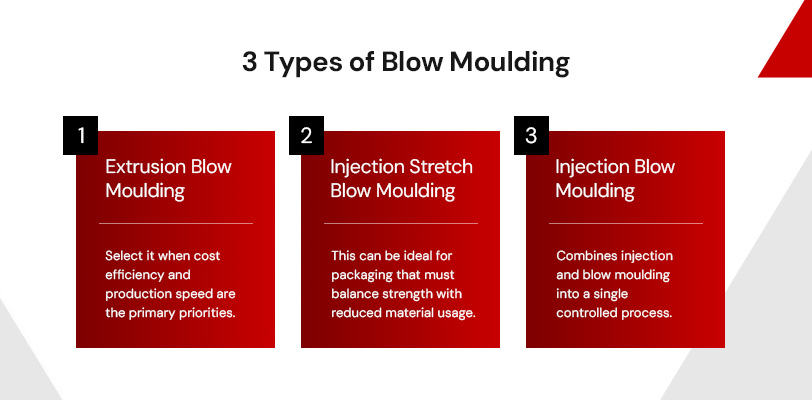
Different blow moulding methods support diverse packaging requirements. Understanding these approaches helps businesses make informed choices.
1. Extrusion Blow Moulding
Select extrusion blow moulding when cost efficiency and production speed are the primary priorities. This method involves inflating a hollow tube of molten plastic, called a parison, inside a mould. Manufacturers use it for larger containers and components where wall thickness variation is acceptable.
2. Injection Stretch Blow Moulding
Injection stretch blow moulding can be ideal for packaging that must balance strength with reduced material usage. Reheating and stretching a preform improves material strength and clarity, making it valuable for applications that require durability and visual consistency.
3. Injection Blow Moulding
Injection blow moulding combines injection and blow moulding into a single controlled process. It involves injection-moulding a preform onto a core pin, then transferring it to a blow station and expanding it to its final shape. This method provides reliable dimensional control and is excellent for packaging components that require precise finishes.
Why Injection Blow Moulding Is Ideal for Precision Packaging
Injection blow moulding is invaluable in rigid package manufacturing, where consistency and repeatability are vital. Many UK FMCG brands trust this process for packaging components that must perform reliably across large production volumes.
High-Precision Neck Finishes
Injection blow moulding allows manufacturers to produce highly accurate neck finishes and threaded components.
- Consistent component fit: Ensures closures and containers assemble correctly.
- Reliable sealing performance: Supports product integrity across distribution.
- Reduced post-processing: Minimises secondary finishing steps.
Waste Reduction and Efficiency
Injection blow moulding has a reputation for material efficiency and repeatability. These qualities matter for businesses focused on sustainability and cost control.
- Minimal flash production: Reduces scrap material.
- Stable cycle times: Results in predictable manufacturing output.
- Material optimisation: Improves resin use across production runs.
Personal Care and Pharmaceuticals
Injection blow moulding supports industries that require precise, clean production.
- Personal care products: Components for deodorant sticks, closures, and jars.
- Pharmaceutical and nutraceutical products: Packaging requiring traceability and quality assurance.
- Health and beauty packaging: Consistent packaging components supporting brand presentation.
Materials Used in the UK Market
Material selection helps in packaging performance, sustainability, and cost management. UK manufacturers frequently use thermoplastics that balance durability, recyclability, and manufacturability.
Thermoplastics
Blow-moulded plastic production supports a wide range of rigid packaging applications across FMCG markets.
- High-density polyethylene: Known for durability, chemical resistance, and recyclability.
- Polypropylene: Offers flexibility, strength, and fatigue resistance.
- Polyethylene terephthalate: Provides clarity, strength, and barrier performance.
Sustainable Alternatives
Sustainability continues to influence packaging design and material selection across the UK manufacturing sector. For many businesses, it is now a core requirement rather than a future initiative.
- Post-consumer resin: Supports circular material use and sustainability goals.
- Lightweighting: Reduces material consumption while maintaining strength.
- Design optimisation: Improves recyclability and manufacturing efficiency.
The Strategic Benefits of a UK-Based Manufacturing Partner
Working with a regional manufacturing partner offers operational and strategic advantages for UK-based filling lines and European distribution networks. Local production equals communication, compliance, and faster delivery timelines.
Supply Chain Security and Speed to Market
Supply chain reliability remains a priority for packaging buyers across Europe. Working with a UK manufacturer can provide production continuity.
- Reduced lead times: Shorter transport distances improve delivery reliability.
- Improved collaboration: Easier communication during product development.
- Regional manufacturing stability: Reduced exposure to global shipping disruptions.
Understanding UK Packaging Regulations
Packaging manufacturers in the UK must adhere to strict quality and safety standards, environmental management systems, and food-safety certifications. Working with an experienced partner ensures compliance across regulated markets.
UK Manufacturing Expertise and Innovation
The UK plastics manufacturing sector evolves through automation, material innovation, and process engineering improvements. Manufacturers with in-house teams and project management capabilities can support packaging innovation from concept through production. This integrated approach lets businesses bring new packaging solutions to market more efficiently.
Frequently Asked Questions
Get your pressing questions on plastic blow moulding answered.
1. How Does Blow Moulding Work?
The blow moulding process forms hollow plastic components by heating thermoplastic material, shaping it into a preform, inflating it inside a mould using air pressure, letting it cool, and removing the finished component from the mould.
2. What Materials Are Used in Blow Moulding?
Blow moulding commonly uses thermoplastics such as high-density polyethylene, polypropylene, and polyethylene terephthalate because they offer durability, flexibility, and consistent processing performance. The best material choice depends on the product’s performance requirements, regulatory considerations, and production environment.
3. How Does Blow Moulding Compare to Injection Moulding for Packaging Components?
Blow moulding is excellent for hollow components, while injection moulding is ideal for solid parts or components with complex geometry. Many packaging programmes combine injection and blow moulding, depending on each element’s design requirements.
4. How Long Does It Typically Take to Develop a Blow-Moulded Packaging Component?
Development timelines can vary depending on complexity, validation requirements, and production volume. Many projects move through concept design, prototyping, tooling development, and validation before full production begins.
Select a Reliable Partner for Your Plastic Blow Moulding Needs
Understanding how blow moulding works, what injection blow moulding can accomplish, and the value of working with a UK manufacturing partner can help packaging teams make more confident decisions.
If your business is evaluating packaging development or moulding solutions, you need an experienced global processor. Plastek UK Ltd combines tooling expertise, injection and blow moulding capabilities, and integrated packaging development support across global operations.
https://www.plastekgroup.com/contact-us/Contact us today to find out more about our mould design and manufacturing services.