



Selecting the right plastic manufacturing partner is one of the most critical decisions a business can make when developing packaging or components. The company you choose influences quality, speed to market, cost-effectiveness, and long-term product performance.
Consequently, businesses looking to scale responsibly must seek a reliable industrial partner that understands their industry’s unique demands, offers collaborative development processes, and supports innovation at every phase.
Here are some of the most crucial factors to consider when evaluating manufacturing partnerships.
1. Material Expertise and Selection
The materials used in manufacturing plastics impact everything from shelf life and product safety to recyclability and cost. Your partner should have a firm understanding of common resins like polypropylene (PP), high-density polyethylene (HDPE), and post-consumer resin (PCR), as well as experience working with alternatives like low-density polyethylene (LDPE) and polyethylene terephthalate (PET).
More importantly, they should be able to guide material selection based on your specific requirements. Whether you’re looking for lightweight packaging, improved sealing, or compliance with regional sustainability goals, a capable manufacturer will help you weigh options early so you don’t have to make costly changes later.
2. Technical Capabilities
Ensure your partner has the right tools and systems to support your project, especially if you need custom parts, multi-cavity tooling, or quick turnaround times. For instance, look for plastic manufacturers who invest in state-of-the-art CAD software for part design, simulation tools to detect warping or fill issues, and in-house 3D printing to speed up prototyping. These technologies help predict and resolve potential design challenges before production begins, saving time and cost.
Ask about equipment, too. If you’re planning high-volume runs or multi-component parts, confirm they have the right press sizes, hot runner systems, and robotics for part removal or automated assembly. A strong manufacturing partner invests in cutting-edge tech that ensures consistency and speed across every production phase.
3. Range of Services
Some plastic manufacturers only handle molding. Others can take your project from concept through assembly and final decoration. If you’re trying to simplify your supply chain, reduce handoffs, or improve turnaround times, it’s worth partnering with a company that offers a broader range of services in-house.
Services to look for include:
- Custom mold design.
- Tooling.
- Injection and blow molding capabilities.
- Component assembly.
- Diverse decorating methods like silk screening, pad printing, or hot stamping.
- Value-added services such as high-speed label wrapping, sonic welding, and in-mold labeling.
You may also benefit from rapid prototyping or first-article processes, which help fine-tune design details before full-scale production begins. The more a manufacturing partner can handle internally, the more control you’ll have over lead times, product consistency, quality control, and total cost.
4. Industry-Specific Experience
A production partner’s experience in your sector shortens development cycles and reduces the risk of costly redesigns. For example, packaging for personal care or pharmaceutical and nutraceutical products often involves clean room manufacturing, compatibility with U.S. Food and Drug Administration (FDA) requirements, or specialized sealing.
A partner experienced in your sector can help you avoid common issues like material incompatibility, incomplete fills, or missed compliance steps. They’ll also be familiar with typical product types, whether that’s roll-ons, caps and closures, scoops, or stick containers, and can help you refine specs based on real-world manufacturing constraints.
If your project is highly specialized, make sure the team you’re working with has handled similar components or processes before. That experience can save you weeks or months of trial and error.
5. Design and Engineering Support
Design is where most manufacturing problems start — or get solved. A robust manufacturer partnership should give you access to research and development engineers, design and tooling experts, assembly specialists, and quality control engineers who can help refine your product before it hits the mold.
That includes support for:
- Concept development.
- CAD modeling.
- Moldability reviews.
- Lightweighting.
- Material flow simulations.
The best partners will walk you through early part design reviews (PDRs), suggest tooling improvements based on mold complexity, and help you reduce production risk through prototype testing and digital simulation.
Having design and tooling teams under the same roof speeds up decisions, reduces back-and-forth, and helps your project move forward without unexpected roadblocks. It also gives you a single point of accountability, ensuring nothing gets lost between design and production.
6. Certifications and Regulatory Compliance
Certifications prove that a manufacturer meets industry expectations for quality, safety, and traceability.
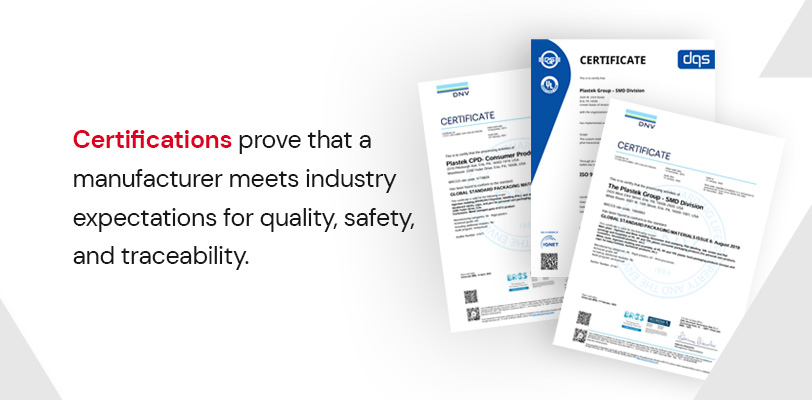
Depending on your product category, you may need a partner that operates under the following:
- International Organization for Standardization (ISO) 9001
- ISO 13485 for medical devices
- FSSC 22000 for food safety
A suitable plastic manufacturing partner should already be working within these frameworks and be able to provide documentation on request. If you manufacture pharmaceuticals, nutraceuticals, or food and beverage products, ask about clean room capabilities, drug master files, and adherence to FDA requirements under 21 CFR Parts 117, 211, and 820.
Aligning with a partner that meets these standards safeguards your reputation and streamlines approval processes. It also assures your customers that your products meet rigorous global requirements.
7. Quality Standards
Beyond certifications, closely examine the manufacturer’s quality assurance and quality control practices throughout the production process. Do they use controlled work instructions, detailed quality plans, and first-article inspection procedures? Do they verify material performance before a lot enters production?
You’ll want a partner that runs daily inspections, tests resin for melt flow and density, and uses automated vision systems and tensile testing equipment. First-article reviews should also include dimensional checks, airflow testing, and leak or torque evaluations, especially if your component will be used in dispensing or containment applications.
A reliable industrial partner will explain their quality strategy and show you how it applies at every step, from design and tooling to molding, assembly, and decorating. Consistent quality systems reduce the likelihood of defects, improve product consistency, and strengthen your ability to meet demanding customer expectations.
8. Pricing
Pricing is always essential, but long-term value goes beyond the lowest quote. A reliable industrial partner provides transparent pricing structures, explains tooling costs, and demonstrates how value-added services such as design optimization or prototyping contribute to overall cost savings.
When comparing bids, consider lifecycle costs, including reduced scrap, fewer defects, and faster lead times. The right manufacturing partner offers a balance of cost efficiency and premium quality.
Evaluate the full value they bring, including in-house design support, material guidance, tooling maintenance, customer service, and overall production reliability. The lowest number on the page isn’t always the best deal, especially if mistakes or delays cost more later.
9. Customer Service and Communication
Strong relationships depend on clear, consistent communication. The best plastic manufacturers assign your account dedicated project managers, engineers, and customer service representatives. They provide regular updates, schedule reviews, and welcome plant visits or video calls to resolve questions quickly. This structure improves responsiveness and helps keep projects on schedule.
Clear communication also encourages collaboration during design, tooling, and production, ensuring your objectives remain the priority. A partner that values transparency becomes an extension of your team rather than a transactional supplier.
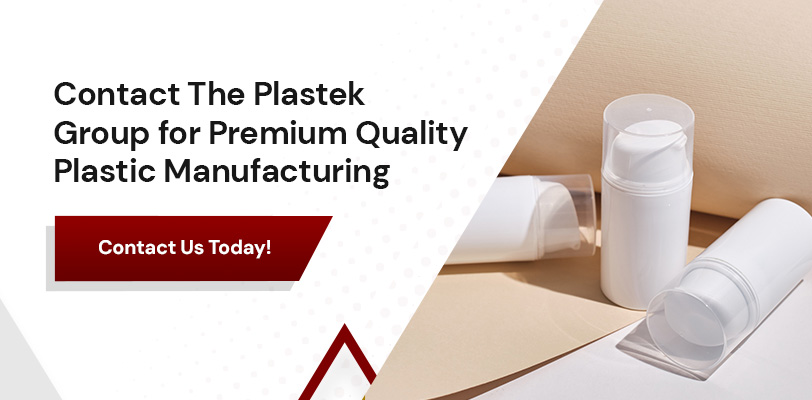
Contact The Plastek Group for Premium Quality Plastic Manufacturing
If you’re evaluating plastic manufacturers for your next packaging project, The Plastek Group brings scale, service, innovation, and technical depth to deliver dependable results. With a global footprint across the United States, the United Kingdom, Brazil, and Mexico, in-house design and tooling, and decades of experience across multiple sectors, we support customers through every development stage.
Whether you’re launching a new product or redesigning packaging for performance or sustainability, our team can help. We specialize in high-volume injection and injection blow molding, multi-component assembly, and complete decorating services with a deep commitment to quality and customer satisfaction.
Partner with us today to streamline production and confidently bring innovative solutions to market.